The Proposed FY 2014 State Budget: Part 2 of 7

The Major Medical Assistance Spending Categories

Last Tuesday, Pennsylvania Governor Tom Corbett unveiled his proposed state FY 2014 budget.  Later that day, members of the Safety-Net Association of Pennsylvania (SNAP) received a comprehensive memo outlining the governor’s budget proposal with an emphasis on the issues that matter most to the state’s 61 private safety-net hospitals.
Over a seven-day period, SNAP presents in this space the highlights of the governor’s budget, again with an emphasis on Medical Assistance and other matters of special interest to Pennsylvania’s safety-net hospitals.   Today, SNAP takes a look at what the proposed budget says about the major Medical Assistance spending categories.
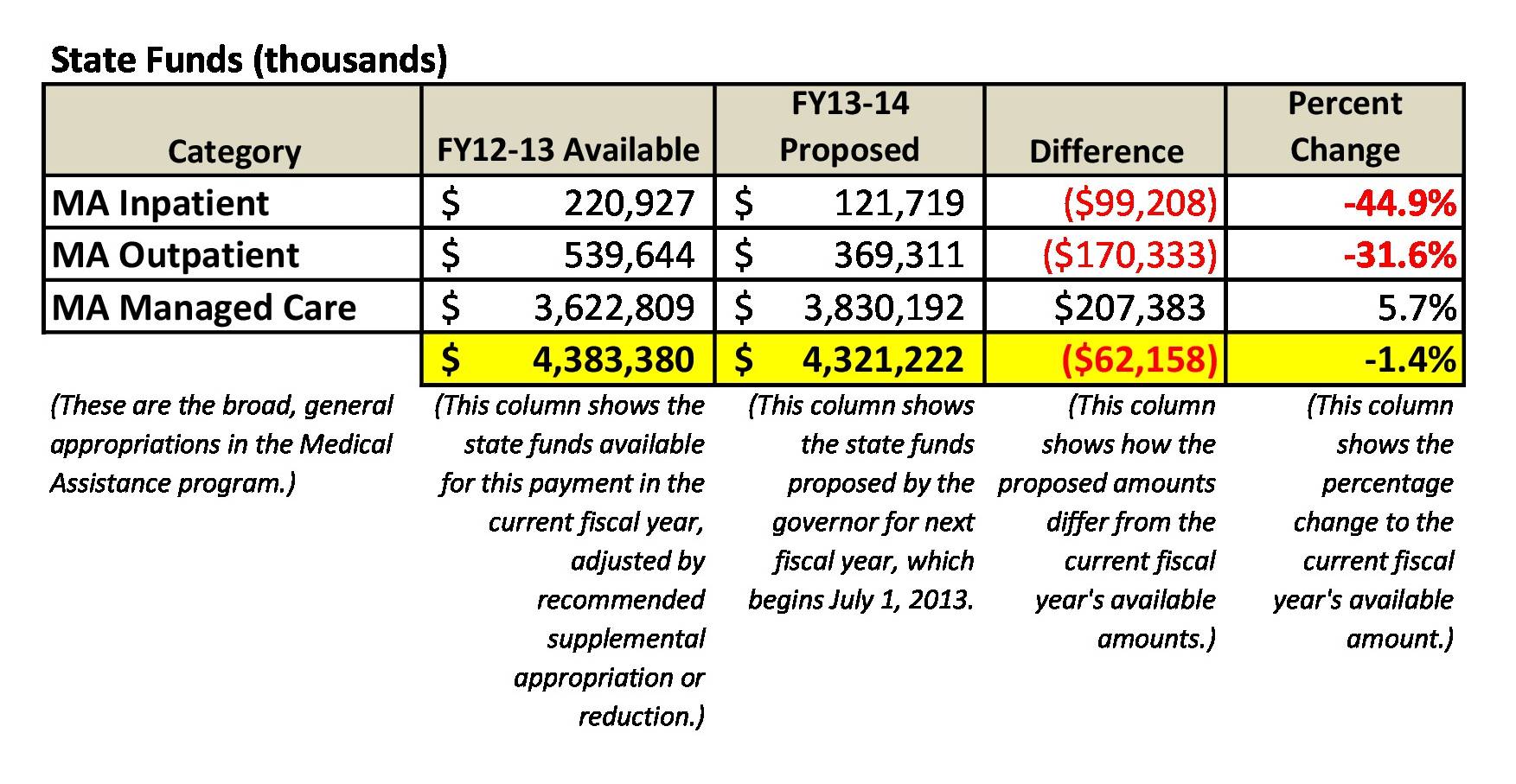
The proposed budget calls for what on the surface appear to be sizeable decreases in state funds available for Medical Assistance inpatient and outpatient funding ­– a decrease of 44.9 percent in inpatient and 31.6 percent in outpatient funding.  What this actually represents, however, is the state’s continued shift toward greater use of managed care through its expanded HealthChoices program, which has been budgeted for a 5.7 percent increase in funding.  Overall, the combined changes in the inpatient, outpatient, and capitation lines of the proposed budget represent a 1.4 percent decrease in the amount of state money available for physical health services.

Click on the accompanying chart to see the proposed changes in the state’s funding allocations for the major categories of Medical Assistance physical health spending from FY 2013 to FY 2014.
Tomorrow:  Hospital Assessment Revenue
 

2013-02-13T06:00:22+00:00February 13th, 2013|Pennsylvania Medicaid policy, Pennsylvania state budget issues, Proposed FY 2014 Pennsylvania state budget, Safety-Net Association of Pennsylvania|Comments Off on The Proposed FY 2014 State Budget: Part 2 of 7

The Proposed FY 2014 Pennsylvania State Budget: Part 1 of 7

The Big Picture

Last Tuesday, Pennsylvania Governor Tom Corbett unveiled his proposed state FY 2014 budget.  Later that day, members of the Safety-Net Association of Pennsylvania (SNAP) received a comprehensive memo outlining the governor’s budget proposal with an emphasis on the issues that matter most to the state’s 61 private safety-net hospitals.
Over the next seven business days, SNAP will present the highlights of the governor’s budget, again with an emphasis on Medical Assistance and other matters of special interest to Pennsylvania’s safety-net hospitals.
The following is a schedule of the remaining six parts of this overview:
Safety-Net Association of Pennsylvania logo
Today:  the big picture underlying the proposed budget.
In this proposed budget, the Department of Public Welfare (DPW) projects a three percent increase in Medical Assistance enrollment and caseload in FY 2014.  Overall, the DPW budget calls for $14.2 billion in total spending on Medical Assistance – a decrease of less than half a percent from the current fiscal year’s available funding.
While some of the proposed changes in the budget are spending decisions, others reflect a reduction in the state’s federal medical assistance percentage, or FMAP (the rate at which the federal government matches state Medicaid spending), which will fall from its current 54.28 percent to an estimated 53.52 percent during FY 2014.  Consequently, in some cases, lower payments would reflect a reduced federal contribution rather than a state decision to reduce those payments.
The major themes of next year’s proposed Medical Assistance budget appear to be a continued state-wide expansion of the HealthChoices Medical Assistance managed care program and expanded access to community-based services for individuals with intellectual disabilities and the elderly.
The budget does not provide for the Medicaid expansion envisioned in the Affordable Care Act.  Governor Corbett has conveyed to the federal government that he will not expand Medicaid eligibility at this time but his document states that such expansion will be the subject of further analysis and public discussion.
Tomorrow:  The Major Medical Assistance Spending Categories
 

PA Says No to Medicaid Expansion (For Now)

Pennsylvania Governor Tom Corbett has at least temporarily closed the door to the Medicaid expansion envisioned in the Affordable Care Act.
On the same day that he presented his proposed state budget for the 2014 fiscal year, Mr. Corbett wrote to U.S. Health and Human Services Secretary Kathleen Sebelius, explaining that

At this time, and without serious reforms, it would be financially unsustainable for Pennsylvania taxpayers, and I cannot recommend a dramatic Medicaid expansion.

See Governor Corbett’s letter to Secretary Sebelius here.
At the same time, however, the governor did not rule out the possibility of a change of heart sometime in the future.  His proposed budget document explains that

 At this time, analysis continues on the financial sustainability related to potential expansion of the Medicaid program.  The Department of Public Welfare continues to have a dialogue with the U.S. Department of Health and Human Services (HHS) in an effort to obtain clarification and answers on a number of issues, including whether essential reforms of the Medicaid program can be accomplished to improve the health of our citizens and the effectiveness of the program.  The department is currently reviewing the recently released proposed regulations on eligibility and benefits from HHS.  While due diligence continues, no decision has been made at this time.

 The administration intends to engage in an informed dialogue with the public and the legislature on whether expansion of the Medicaid program is prudent, affordable and the right choice for the commonwealth.  When a final decision is made, it will be done in consultation with the Legislature and it may require modifications to be made and accounted for in the budget.

The Safety-Net Association of Pennsylvania (SNAP) supports Medicaid expansion in the state.

2013-02-07T06:00:12+00:00February 7th, 2013|Health care reform, Pennsylvania Medicaid policy, Pennsylvania state budget issues, Safety-Net Association of Pennsylvania|Comments Off on PA Says No to Medicaid Expansion (For Now)

Proposed State Budget: Implications for PA Safety-Net Hospitals

Yesterday, Pennsylvania Governor Tom Corbett unveiled his proposed FY 2014 budget in a speech to the state’s General Assembly.
Safety-Net Association of Pennsylvania logoThe Safety-Net Association of Pennsylvania (SNAP) has prepared a detailed summary of the budget proposal with an emphasis on provisions of particular importance to the state’s safety-net hospitals.  To receive a copy of this memo, please contact SNAP at info@pasafetynet.org.

2013-02-06T06:00:23+00:00February 6th, 2013|Medicaid supplemental payments, Pennsylvania Medicaid policy, Pennsylvania state budget issues, Safety-Net Association of Pennsylvania|Comments Off on Proposed State Budget: Implications for PA Safety-Net Hospitals

Handicapping Medicaid Expansion in PA

Will he or won’t he?
That question is still on the minds of many as Pennsylvania Governor Tom Corbett continues neither to declare that the state will expand its Medicaid program as provided for in the Affordable Care Act nor to confirm the suspicion of most observers that he will choose not to expand the program beyond its current 2.2 million recipients.
As of right now, 12 states appear to be undecided about Medicaid expansion.  The Safety-Net Association of Pennsylvania (SNAP) supports Medicaid expansion.
For a closer look at the situation in Pennsylvania, including an account of which interest groups are for expansion and which are not as enthusiastic as one might expect, read this columnHarrisburg, PA capital building from the Central Penn Business Journal.

2013-02-01T06:00:35+00:00February 1st, 2013|Health care reform, Pennsylvania Medicaid policy|Comments Off on Handicapping Medicaid Expansion in PA

States Finding it Hard to Say No to Federal Medicaid Money

While many of the nation’s governors have ideological problems with many aspects of the Affordable Care Act, it appears that more of them are preparing to accept one major facet of the bill with which they particularly disagree:  Medicaid expansion.
When the law passed, the mandatory expansion of Medicaid eligibility was one of its most controversial aspects and encountered a great deal of resistance from many governors.  When the Supreme Court ruled last year that the mandate was unconstitutional, many governors indicated that they would decline the now-optional Medicaid expansion.
But as the time for implementing the Medicaid expansion draws closer, more governors are concluding that the lure of millions, and even billions, of “free” federal Medicaid matching dollars is too hard to resist.
In addition, some governors are concerned about appearances if they turn down the federal Medicaid money while a clause in the reform act would enable legal immigrants in their state to receive health insurance premium subsidies while other low-income residents remain ineligible for those subsidies and uninsured.
Pennsylvania Governor Tom Corbett has not yet announced his decision on whether the state will expand its Medicaid program but appears to be leaning against such an expansion.  The Safety-Net Association of Pennsylvania (SNAP) supports Medicaid expansion in the commonwealth.
Read about the challenges governors face in refusing the federal Medicaid money in this RealClearPolitics article and about the immigration twist on the issue in this Washington Post report.

2013-01-28T06:00:29+00:00January 28th, 2013|Health care reform, Pennsylvania Medicaid policy, Safety-Net Association of Pennsylvania|Comments Off on States Finding it Hard to Say No to Federal Medicaid Money

PA Paves Way for Primary Care Pay Raise

The Pennsylvania Department of Public Welfare has published a notice that it will increase the fees Medical Assistance pays for selected primary care services.
The pay raise, funded 100 percent by the federal government, is part of the Affordable Care Act.
For further information about the pay raise, which physicians qualify for it, and how they can receive the pay raise, see the notice here, in the Pennsylvania Bulletin.
In addition, members of the Safety-Net Association of Pennsylvania (SNAP) have received a detailed memo outlining the terms of the Medicaid primary care pay raise.  Members who have not seen the memo and others who would like a copy can request it at info@paysafetynet.org.

2013-01-07T06:00:48+00:00January 7th, 2013|Health care reform, Pennsylvania Bulletin, Pennsylvania Medicaid policy, Safety-Net Association of Pennsylvania|Comments Off on PA Paves Way for Primary Care Pay Raise

SNAP Seeks Provider Fee Help from PA Congressional Delegation

In a message to members of Pennsylvania’s congressional delegation, the Safety-Net Association of Pennsylvania (SNAP) has asked elected officials in Washington, D.C. to protect the state’s ability to levy assessments on providers to help fund the commonwealth’s Medicaid program.  The proceeds from the state’s current provider assessments, SNAP notes, have made a major difference in ensuring the ability of Pennsylvania’s safety-net hospitals to continue serving their many Medicaid patients.
Read SNAP’s message to the Pennsylvania congressional delegation hereSafety-Net Association of Pennsylvania logo.

2012-12-26T15:00:08+00:00December 26th, 2012|Safety-Net Association of Pennsylvania|Comments Off on SNAP Seeks Provider Fee Help from PA Congressional Delegation

PA Welfare Secretary Testifies About Medicaid Expansion

Declaring that “We in the commonwealth have never witnessed a law so vast, with such demands on state resources, and lack of federal guidance,” Pennsylvania Department of Public Welfare Secretary Gary Alexander told the House Energy and Commerce Committee last week that while Pennsylvania has not ruled out expanding its Medicaid program in accordance with the Affordable Care Act, “Under the constraints of the health care reform law, I do not think we can afford the expansion.”
Mr. Alexander made these remarks at a hearing of the committee’s Health Subcommittee, which was taking testimony on the Medicaid expansion component of the 2010 health care reform law.
While the Kaiser Foundation on Medicaid and the Uninsured says that expansion would cost Pennsylvania $2 billion through 2022, the Corbett administration has put a $4 billion price tag on such expansion.
The Safety-Net Association of Pennsylvania (SNAP) supports Medicaid expansion in the state.
Read more about Mr. Alexander’s testimony in this Pittsburgh Post-Gazette article and this Central Penn Business Journal article, which also includes a direct link to the secretary’s testimony.

2012-12-18T06:00:03+00:00December 18th, 2012|Health care reform, Pennsylvania Medicaid policy, Safety-Net Association of Pennsylvania|Comments Off on PA Welfare Secretary Testifies About Medicaid Expansion

HHS Nixes Partial Medicaid Expansion

States must opt into the Affordable Care Act’s Medicaid expansion or opt out, the federal government has informed the nation’s governors.  They may not implement a partial expansion.
That was the message conveyed to governors by Kathleen Sebelius, Secretary of the U.S. Department of Health and Services (HHS).
The Medicaid expansion, made mandatory in the 2010 health care reform law, has been the subject of much debate since the Supreme Court ruled the mandate unconstitutional in June and instead left the decision on whether to expand to the individual states.  Some governors have already declared that their states will expand their Medicaid programs, some have announced that they will not, and many still have not decided.
Pennsylvania is among the states that have not yet announced whether they will expand their Medicaid programs, although Governor Tom Corbett has signaled that he is reluctant to incur the additional costs that expansion would involve.  The Safety-Net Association of Pennsylvania (SNAP) supports Medicaid expansion.
Read more about this latest decision from HHS in this Washington Post article and read an FAQ that HHS sent to governors regarding both Medicaid expansion and the operation of health insurance exchanges here.

2012-12-11T11:19:30+00:00December 11th, 2012|Health care reform, Pennsylvania Medicaid policy, Safety-Net Association of Pennsylvania|Comments Off on HHS Nixes Partial Medicaid Expansion
Go to Top