

COVID-19 Update: Monday, February 22
The following is the latest COVID-19 information from the federal and state government as of 4:30 p.m. on Monday, February 22.
Pennsylvania Update
 Governor Wolf
Governor Wolf has renewed his declaration of a state of emergency in Pennsylvania because of COVID-19. See the announcement of the renewal and the renewal declaration itself, which covers a period of 90 days.
Department of Health – by the numbers
- The number of new daily cases continues to decline
- In the past week the number of COVID-19 deaths has fallen significantly.
- More than 24,000 health care workers in Pennsylvania have contracted COVID-19, as have nearly 79,000 residents and employees of long-term-care facilities across the state. The continual increase in these numbers since the start of the pandemic has slowed considerably.
- For the week from February 12 through February 18 the state’s overall COVID-19 test positivity rate fell to 6.5 percent; it was 8.0 percent the week before that. This marked the ninth consecutive week the rate fell.
- The number of Pennsylvanians hospitalized with COVID-19 is just 60 percent of what it was at the beginning of February; the number in hospital ICUs is 64 percent of what it was at the beginning of the month; and the number on ventilators is 57 percent of what it was three weeks ago.
- Currently, 24 percent of adult ICU beds in the state are unoccupied, as are 21 percent of medical/surgical beds, nine percent of pediatric ICU beds, 32 percent of pediatric beds, and 40 percent of airborne isolation units.
- As of February 22 the state’s vaccine dashboard shows that 916,000 Pennsylvanians have received their first dose of a COVID-19 vaccine and 541,000 have received both doses of vaccine. These numbers do not include Philadelphia, which operates its own COVID-19 vaccination program.
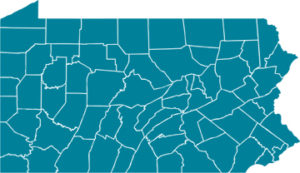
- The vaccine dashboard shows vaccine totals by county.
Department of Human Services
DHS has posted a COVID-19 vaccine FAQ.
 Department of State
The Department of State has authorized licensed pharmacists to delegate authority to administer COVID-19 vaccines to other licensed health care practitioners whose scope of practice includes the administration of injectable vaccines, such as LPNs, RNs, physicians, and physician assistants. Under ordinary circumstances pharmacists may only oversee other pharmacists and pharmacy interns involved in providing immunizations and may not delegate the task of immunization. This waiver applies solely to COVID-19 vaccines and lasts only for the duration of the governor’s disaster emergency declaration plus an additional 90 days thereafter, unless terminated sooner.
General Assembly
Efforts are under way in the state legislature to introduce bills creating a system of centralized registration for COVID-19 vaccines in Pennsylvania. Learn more from memos seeking co-sponsors for such legislation that are currently circulating in the state House and the state Senate.
Around the State
- Last week’s snow delayed the shipment of vaccines around the state, including to Lehigh County and Allegheny County.
- A 24-hour walk-in vaccination event in Philadelphia, open only to residents of selected zip codes, vaccinated more than 4000 people, the Philadelphia Inquirer reports
- COVID-19 hospitalizations are declining in Allegheny County. The Pittsburgh Tribune-Review explores why.
Resources to Consult
Pennsylvania Department of Human Services
Pennsylvania Department of Health
Centers for Disease Control and Prevention
Federal Update
 Centers for Medicare & Medicaid Services
- CMS has updated its FAQ on Medicare COVID-19 billing issues with 13 new questions addressing vaccines, monoclonal antibody treatments, and ambulatory surgery centers functioning as acute-care hospitals during the public health emergency. The questions, all labeled “2/19/2021,” can be found on pages 27-28, 135-137, and 152-153.
Department of Health and Human Services
- HHS has updated its Provider Relief Fund FAQ with an updated question about how applicants should set up an account of behalf of multiple subsidiaries as part of applying for a Phase 3 distribution. Find the updated question on page 42.
HHS and CMS COVID-19 Stakeholder Calls
HHS Clinical Rounds Peer-to-Peer Virtual Communities of Practice
HHS’s Office of the Assistant Secretary for Preparedness and Response sponsors COVID-19 Clinical Rounds Peer-to-Peer Virtual Communities of Practice that are interactive virtual learning sessions that seek to create a peer-to-peer learning network in which clinicians from the U.S. and abroad who have experience treating patients with COVID-19 share their challenges and successes. These webinar topics are covered every week:
- EMS: Patient Care and Operations (Mondays, 12:00-1:00 PM eastern)
- Critical Care: Lifesaving Treatment and Clinical Operations (Tuesdays, 12:00-1:00 PM eastern)
- Emergency Department: Patient Care and Clinical Operations (Thursdays, 12:00-1:00 PM eastern)
Go here for information about signing up to participate in the sessions and go here for access to materials and video recordings of past sessions.
CMS Stakeholder Calls
CMS hosts recurring stakeholder engagement sessions to share information about the agency’s response to COVID-19. These sessions are open to members of the health care community and are intended to provide updates, share best practices among peers, and offer participants an opportunity to ask questions of CMS and other subject matter experts.
CMS COVID-19 Office Hours Calls
Tuesday, February 23 at 5:00 – 6:00 PM (eastern)
Toll Free Attendee Dial In: 833-614-0820; Access Passcode: 2528725
Tuesday, March 16 at 5:00 – 6:00 PM (eastern)
Toll Free Attendee Dial In: 833-614-0820; Access Passcode: 4177586
Audio Webcast link: go here
Tuesday, April 6 at 5:00 – 6:00 PM (eastern)
Toll Free Attendee Dial In: 833-614-0820; Access Passcode: 2769397
Audio Webcast link: go here
 Centers for Disease Control and Prevention
- The CDC has updated its toolkit for communicating with essential workers about the importance of receiving COVID-19 vaccines.
- The CDC has updated its FAQ about COVID-19 vaccines.
- The CDC has updated its resources for communicating with different audiences about COVID-19 vaccines.
- The CDC has updated its data on COVID-19 variant cases in the U.S.
- The CDC has updated its COVID-19 resources for people with disabilities.
- The CDC has updated its COVID-19 resources for older adults.
- The CDC has updated its collection of resources about COVID-19 for people with selected medical conditions
Food and Drug Administration
- The FDA has published guidance for industry on the development of monoclonal antibody products targeting COVID-19, including emerging variants of COVID-19.
 The increase has been driven by rising COVID-19 pandemic-related unemployment that has cost many people their health insurance along with their jobs.
 Department of Health
 As of February 17 the state’s
  Governor Wolf has created a COVID-19 Vaccine Joint Task Force with administration representatives and “…members from each legislative caucus who can share vaccine information and communicate issues and solutions expediently on behalf of and to the broader General Assembly.” According to
  Department of Health – by the numbers
 The White House
 Department of Health
 The bill also should include additional targeted funding for safety-net hospitals, help with staffing, an extension of the current moratorium on the Medicare sequestration, and forgiveness for safety-net hospitals for loans they received under the Medicare Accelerated and Advance Payment Program.
 Department of Human Services
 Resources to Consult
 extend the postpartum coverage period for individuals who were eligible and enrolled in Medicaid while pregnant to a full year of coverage, regardless of changes in income. Services provided to individuals during the extended postpartum coverage period will receive an enhanced 100 percent federal matching rate;
 Building on the overwhelming bipartisan support to establish the state-based health insurance exchange in Pennsylvania, increasing access to affordable care and saving money for both the state and taxpayers, Governor Wolf offers a plan that addresses comprehensive health reforms focusing on both physical and behavioral health and promoting affordability, accessibility and value in health care. The Health Value Commission, a key component to the health reform package, would be charged with keeping all payors and providers accountable for health care cost growth, to provide for the long-term affordability and sustainability of our health care system, and to promote whole-person care.