
MFAR Backlash Continues
Diverse health care and government interests are rallying around their opposition to the proposed Medicaid fiscal accountability rule.
 The regulation, proposed by the Centers for Medicare & Medicaid Services in November would impose new limits on the ability of states to finance their share of their Medicaid spending, potentially jeopardizing provider payments and the ability of high-volume Medicaid providers to operate without suffering great losses.
In all, CMS received more than 4200 written comments in response to the proposed regulation, most of them expressing opposition. Among those doing so were state governments, the National Governors Association, hospitals and hospital associations, nursing home operators, and health advocacy organizations. Also among them was the Safety-Net Association of Pennsylvania. In summarizing its opposition, SNAP wrote in a formal comment letter to CMS on behalf of Pennsylvania safety-net hospitals that
SNAP is concerned that this proposed regulation would inappropriately restrict the state’s ability to finance the non-federal share of the Medicaid program, would impose significant additional regulatory burdens – the cost of which would far outstrip their benefit – would inappropriately introduce subjectivity into the application of previously clear and objective regulatory standards, and is beyond the scope of the statutory authority granted to CMS.
See SNAP’s entire letter here.
Learn more about the Medicaid fiscal accountability rule, what it seeks to do, and why so many oppose in the Stateline article “Medical Groups Slam Trump Medicaid Rule.”
 Under federal law, CMS must publish a notice declaring its intention to collect such data and seek input from stakeholders. For this particular notice, stakeholders have until March 9 to respond.
 The proposed budget, presented to the state legislature earlier this week, includes the following new initiatives:
 Authorization for delaying the cut in allotments to the states, which would have resulted in reduced Medicaid DSH payments for many hospitals – including private safety-net hospitals – would expire on May 22. Congress is expected to address Medicaid DSH, along with surprise medical bills, the price of prescription drugs, and other health care matters, before that time.
 The Prescription Drug Pricing Reduction Act includes a provision that would eliminate two years of Affordable Care Act-mandated cuts in the allocation of federal money to the states for Medicaid disproportionate share hospital payments (Medicaid DSH). Those cuts have been delayed several times by Congress but were scheduled to begin in October of 2019 and run through federal FY 2025, only to be delayed again twice by continuing resolutions adopted by Congress to fund the federal government in the absence of enacted appropriations bills.
 According to the bond rating agency, non-profit hospitals are seeing growing amounts of bad debt as they struggle, often unsuccessfully, to collect from patients whose high deductibles leave them on the hook for meaningful amounts of care.
 The Philadelphia Business Journal reports that since Hahnemann’s closing was announced during the summer, ER volume has risen 15 percent, admissions have risen 12 percent, and births have risen more than 50 percent at Thomas Jefferson University Hospital, a SNAP member. Meanwhile, SNAP member Pennsylvania Hospital has seen its ER visits rise nine percent, SNAP member Penn Presbyterian Medical Center has seen its ER volume increase five percent, and SNAP member the Hospital of the University of Pennsylvania has seen its ER volume rise five percent.
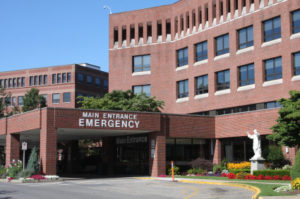 This area is served almost exclusively by Pennsylvania safety-net hospitals and recently suffered a major loss when one of those providers, Hahnemann University Hospital, closed its doors.
  Instead, patients previously served by Hahnemann University Hospital, a Pennsylvania safety-net hospital that served especially large numbers of Medicaid and uninsured patients, are now being served by other safety-net hospitals in Philadelphia: mostly, Jefferson Health, the University of Pennsylvania Health System, Einstein Healthcare Network, and Temple University Hospital. All report increased volume in their emergency rooms, more ambulance arrivals, and more inpatient admissions, but at least so far, they also report that they are comfortably handling the increased patient volume created when Hahnemann closed its emergency room and discharged its last patients in July.